Seven Years, a Hundred Rooms, No Lease Longer Than Three
The East Village gallery boom of 1981–1988 was brief, overcrowded, genre-defining and, in the end, entirely predictable — a borough-wide pattern compressed into seven blocks.
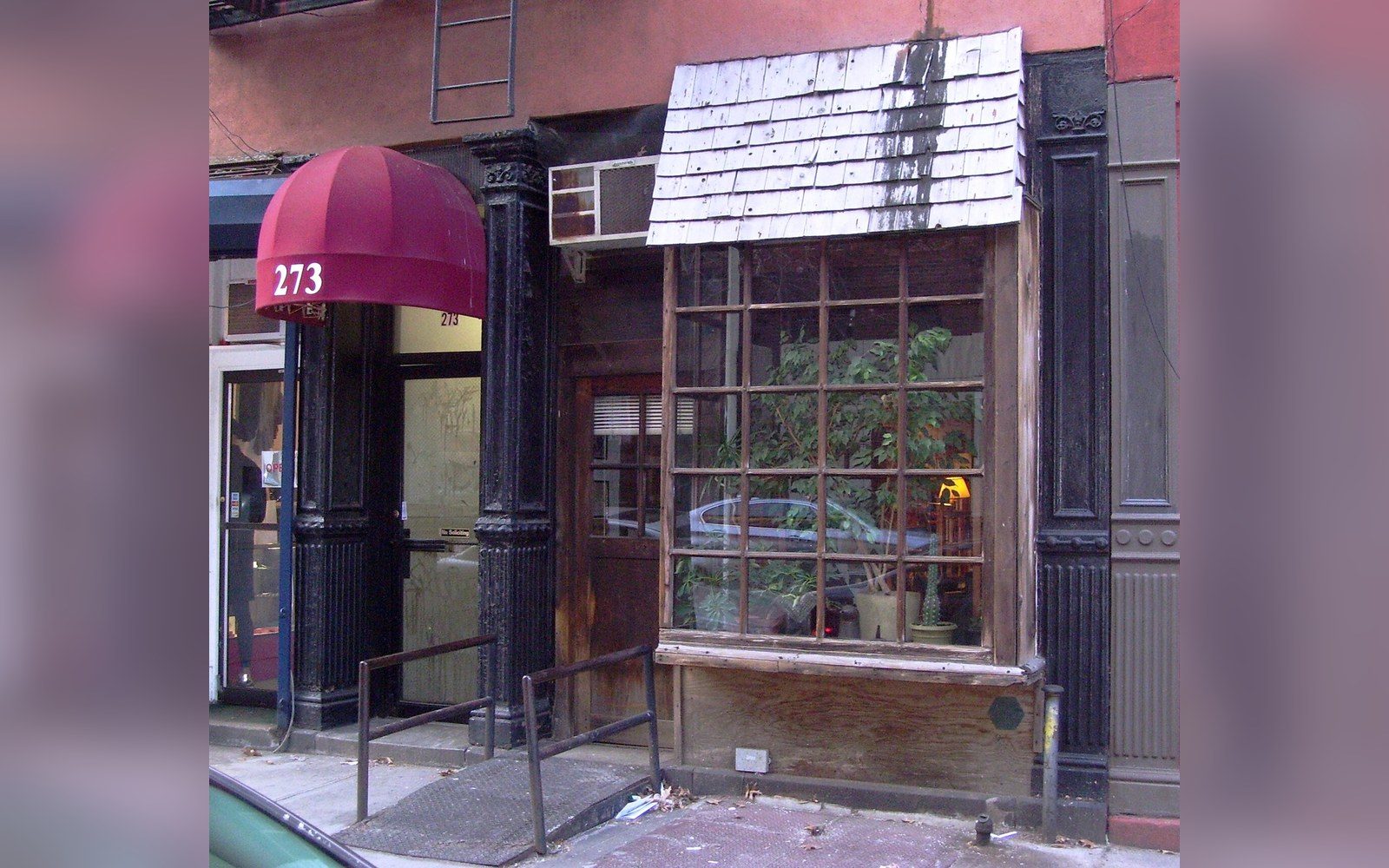
The East Village gallery blocks, Avenues A to C and East 7th to East 11th: over eighty spaces at their 1984 peak.
Photo: 273 East 10th Street · Wikimedia Commons
The Geography of a Scene
The map was small. Between roughly Avenue A and Avenue C, from East 7th Street to East 11th, a neighbourhood that had spent the 1970s absorbing arson, abandonment and the wreckage of New York City's fiscal collapse suddenly became, between 1981 and 1984, one of the densest concentrations of commercial art space in the United States. The buildings were tenements and former bodegas, the ceilings low, the floors uneven. None of this was the soaring cast-iron loft space that had made SoHo's gallery district legible to collectors. That was precisely the point.
The neighbourhood had been home to Puerto Rican and Ukrainian communities for decades, and by the late 1970s it also sheltered a generation of artists priced out of SoHo almost as soon as SoHo had become a going concern. The galleries that arrived after 1981 were not suburban converts discovering downtown; they were operators who understood that cheapness was a programming decision. A storefront on East 10th Street leased for a few hundred dollars a month. A dealer could open without capital, run without staff, close without loss, and show work that no West Broadway gallery would consider.
Outside the city the same trade needs acreage, and a figure in the frame is the only way to show it.
Photo: Maurice Engelen / Pexels
The two spaces that defined the scene's ambitions most legibly were Fun Gallery, which Patti Astor and Bill Stelling opened at 254 East 10th Street in 1981, and International With Monument, which Elizabeth Koury ran at a storefront on East 7th Street from 1983 to 1988. Fun Gallery put graffiti artists — Futura, Lee Quiñones — into a white-cube context and sold Jean-Michel Basquiat before his market was fully legible; International With Monument represented Peter Halley, Meyer Vaisman and Jeff Koons in the years just before each of them became a critical event. The two spaces could not have been less alike in sensibility, and they shared a neighbourhood, a rent bracket and a finite lifespan.
Eighty Spaces, Three Good Years
By 1984, contemporaneous accounts documented more than eighty gallery spaces operating in the East Village. The figure is sometimes given as a hundred, depending on whether one counts project spaces, artist-run studios with an open-door policy, and the revolving series of pop-up exhibitions mounted in apartments. In any case, the concentration was extraordinary for a district that had seen no commercial art activity five years earlier. The ADAA, whose membership rolls were dominated by 57th Street and SoHo stalwarts, had little presence here; the East Village operated on its own informal economy.
The dealers who made careers from the moment were a minority. Most of the eighty-odd spaces lasted between one and three years, which was the typical length of the leases their landlords offered — short terms that landlords preferred precisely because they retained the right to reprice. A dealer who opened in 1983 on a two-year lease at a rent fixed to the neighbourhood's distressed condition found, on renewal in 1985, a landlord who had read the same newspaper coverage the collectors had. The mechanism was automatic.
- 1981Fun Gallery opens at 254 East 10th Street; earliest anchor of the East Village scene
- 1983International With Monument opens on East 7th Street; peak of new gallery openings begins
- 1984contemporaneous accounts record more than 80 gallery spaces operating in the district
- 1985–86rent increases accelerate; gallery attrition begins in earnest
- 1988International With Monument closes; Fun Gallery already shuttered; scene effectively over
Still, for perhaps three years — 1983, 1984, 1985 — the scene produced real critical mass. Group shows moved between spaces; openings on a Saturday night on East 10th drew the same collectors who would show up Monday morning at Mary Boone on West Broadway. The art press treated the East Village as both a sociological story and a market story simultaneously, which accelerated both the prices and the rents. Julian Schnabel, whose reputation had been built in SoHo, became associated in the cultural press with the neighbourhood's energy even though his primary commercial relationship remained uptown. Jean-Michel Basquiat's presence — as both an exhibiting artist and a neighbourhood figure — gave the district a symbolic gravity that no single work or show could fully account for.
The Collapse and What It Taught
By 1986 the contraction was visible to anyone paying attention. Rents that had doubled once were doubling again. A storefront that had been released to a gallery for four hundred dollars a month in 1982 could command twelve hundred or more by 1986, and the landlords knew that residential conversion or retail use would pay more than art. Galleries that had never operated at a profit — because profit was not quite the model — found that even the low overhead they had designed around was no longer attainable. By 1988, the concentration had largely dissolved. Some dealers relocated to SoHo, where rents were also rising but more slowly, or ceased operating entirely. Elizabeth Koury closed International With Monument in 1988; Fun Gallery had already shuttered. The neighbourhood returned to the residential and commercial uses that had always coexisted with the art moment, and the art press moved on to ask whether the East Village had been a genuine movement or a market bubble wearing one's clothes.
The question underestimates what remained. The careers that the East Village launched or accelerated — Basquiat, Koons, Halley, Vaisman, Schnabel in his later phase — proved durable across the following decades regardless of what happened to the real estate. The galleries themselves were vehicles, temporary and intentionally so. What distinguished the East Village from earlier New York gallery concentrations was not the quality of the art or the sophistication of the dealing but the speed of the rent curve and the transparency with which it operated. SoHo took roughly a decade to price out its founding galleries; the East Village took half that. Chelsea, which became the dominant gallery district after the mid-1990s, would repeat the pattern on a longer timeline and a larger scale.
The two spaces that defined the scene's ambitions most legibly were Fun Gallery, which Patti Astor and Bill Stelling opened at 254 East 10th Street in 1981, and International With Monument, which Elizabeth Koury ran at a storefront on East 7th Street from 1983 to 1988.
The East Village gallery moment was not an anomaly in New York's art geography — it was a compressed, legible version of the standard sequence: artists colonise cheap space, dealers follow, press arrives, collectors arrive, rents rise, galleries exit. The lesson the city's art trade took from it was less about neighbourhood character than about lease structure: a gallery that wanted to outlast the cycle needed ownership, not a three-year term. The dealers who survived the following decades in Chelsea — Gagosian, Zwirner, Matthew Marks, Paula Cooper — were in large part those who either owned their buildings or signed long enough leases to ride out the first rent shock. The East Village taught that, if nothing else.
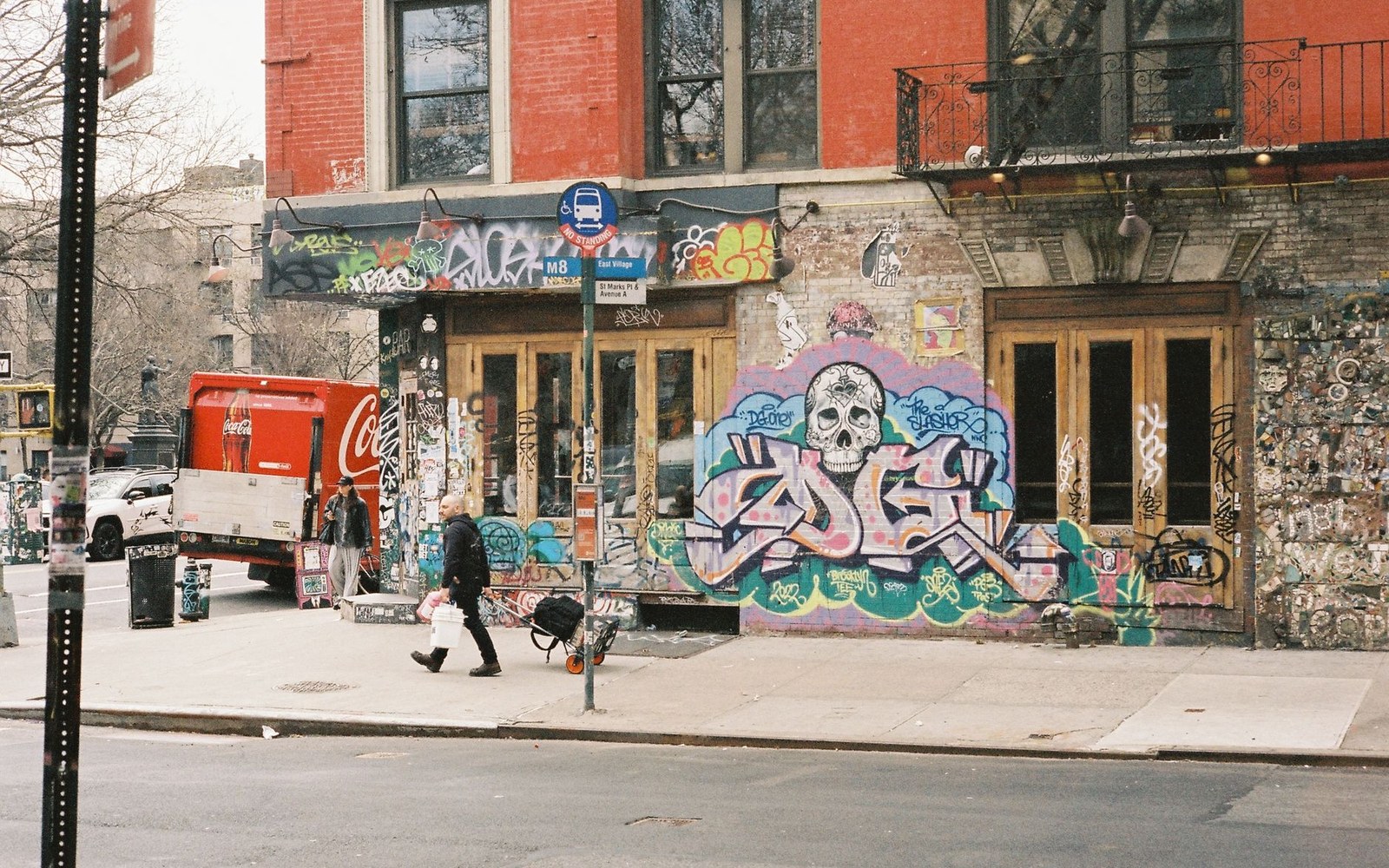
Elsewhere in East Village: The Fun Gallery, 254 East 10th Street, opened 1981 — the first commercial storefront to hang Futura, Lee Quiñones and Basquiat. Patti Astor and the Fun Gallery on East 10th
Photo: Alec Doualetas / Pexels