The 69th Regiment Armory and the Show That Changed the Count
Four weeks in 1913 brought tens of thousands of New Yorkers face to face with European modernism — and nothing in the American art world recovered.
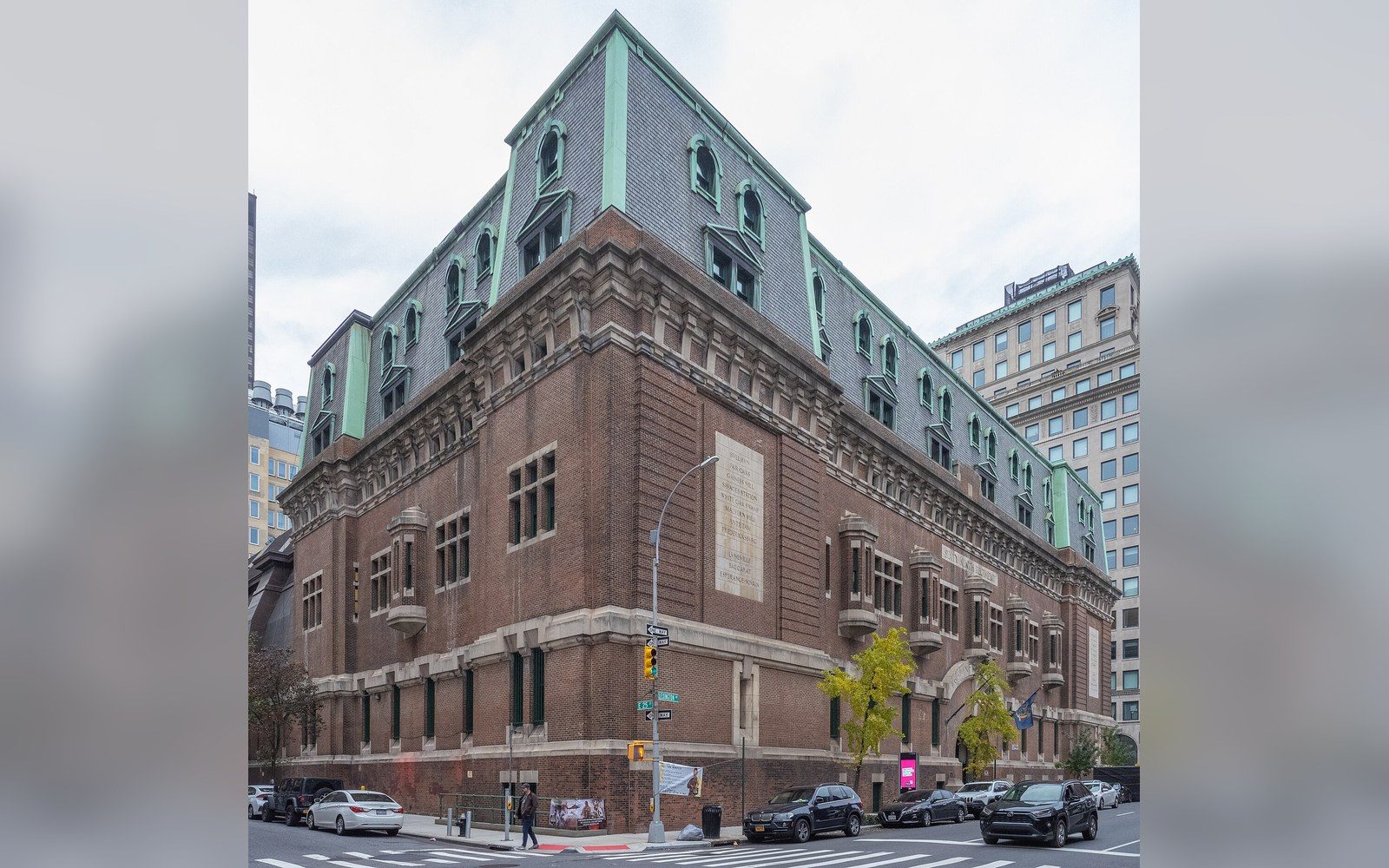
The 69th Regiment Armory on Lexington Avenue, which held roughly 1,300 works at the 1913 International Exhibition of Modern Art.
Photo: 69th Regiment Armory · Wikimedia Commons
The Building and the Shock It Contained
The 69th Regiment Armory on Lexington Avenue at 25th Street was not built to house art. Completed in 1906, it was a drill hall — a vast, barrel-vaulted space designed for formations, not contemplation. The Association of American Painters and Sculptors, led by painter Arthur B. Davies, rented it for February 17 through March 15, 1913, and filled it with approximately 1,300 works gathered from European studios and American collections. The show's formal title was the International Exhibition of Modern Art. Almost everyone called it the Armory Show.
The organizers had spent months in Europe, working with dealers including Ambroise Vollard and Daniel-Henry Kahnweiler to assemble a survey of Post-Impressionism, Fauvism and Cubism that American audiences had, for the most part, never seen in depth. Cézanne, Gauguin, Van Gogh and Seurat arrived as historical pillars. Matisse, Picasso, Braque and Duchamp arrived as the crisis.

The back office is where a district is actually run: leases, shipping schedules and the artists’ accounts.
Photo: Nic Wood / Pexels
Marcel Duchamp's Nude Descending a Staircase, No. 2 (1912) became the single most discussed object in the room. The painting's fragmentation of a body in motion — drawn from Cubism and from early motion photography — struck newspaper critics as either a joke or an affront. Theodore Roosevelt visited and compared it unfavorably to a Navajo rug. The cartoonists went to work; the crowds came to look. The painting was sold during the run to San Francisco dealer Frederic Torrey, which was itself news: European modernism was not merely on display, it was for sale.
What the Numbers Actually Show
Attendance for the New York run reached somewhere between 70,000 and 90,000 paid visitors over roughly four weeks — a figure that, by the institutional standards of 1913, was remarkable for a commercial-adjacent art exhibition. The show then traveled to the Art Institute of Chicago (where attendance exceeded New York, crossing 188,000) and to Copley Hall in Boston. Roughly a third of the works in the New York presentation were sold, generating enough revenue to cover expenses and leave a surplus.
The cultural accounting was harder to close. American critics who arrived dismissive often left unsettled. Several collectors — including John Quinn, who had helped finance the enterprise, and Walter Arensberg, who would later give his collection to Philadelphia — began acquiring European modernism directly as a result of the exhibition. The institutional infrastructure did not follow immediately: MoMA would not open until 1929, and the first dedicated commercial galleries for advanced European work on 57th Street would take another decade to consolidate. But the Armory Show established, in one season, that a New York audience existed for this material and that the city's dealers would eventually have to decide what to do about it.
- 190669th Regiment Armory completed on Lexington Avenue at 25th Street
- February 17 – March 15, 1913International Exhibition of Modern Art, New York run
- 1913Chicago presentation exceeds 188,000 visitors at the Art Institute
- 1929MoMA opens, the institutional infrastructure the Armory Show anticipated
- 1994Gramercy International Art Fair founded, forerunner of the Armory Show fair
- 1999Fair renamed the Armory Show, moves to the Hudson River piers
The Name It Left Behind
In 1994, the Gramercy International Art Fair launched at the Gramercy Park Hotel, and by 1999 it had relocated and rebranded as the Armory Show — explicitly invoking 1913 as its frame of reference. The contemporary fair took up the Hudson River piers: Piers 90 and 94, later consolidated on Pier 94, then relocated again. The scale inverted the original's logic. Where 1913 had crammed a radical survey of European modernism into a military drill hall, the modern fair spread hundreds of galleries across a pier shed purpose-fitted for art-fair traffic, with a program oriented toward the primary market rather than curatorial argument.
The 69th Regiment Armory itself survives as a New York City landmark, still in use by the National Guard and occasionally by cultural events. The building's 1913 moment remains the fixed point from which every subsequent account of modernism's American arrival must take its bearings.
Marcel Duchamp's *Nude Descending a Staircase, No.

Elsewhere in Downtown: Frieze New York, from the Randall’s Island tent of 2012 to the Shed at Hudson Yards. Frieze Moves Off the Island
Photo: Airam Dato-on / Pexels