Henri's Son, Dealing on 57th
The Pierre Matisse Gallery made 41 East 57th Street the most European address in the American art trade — for half a century.
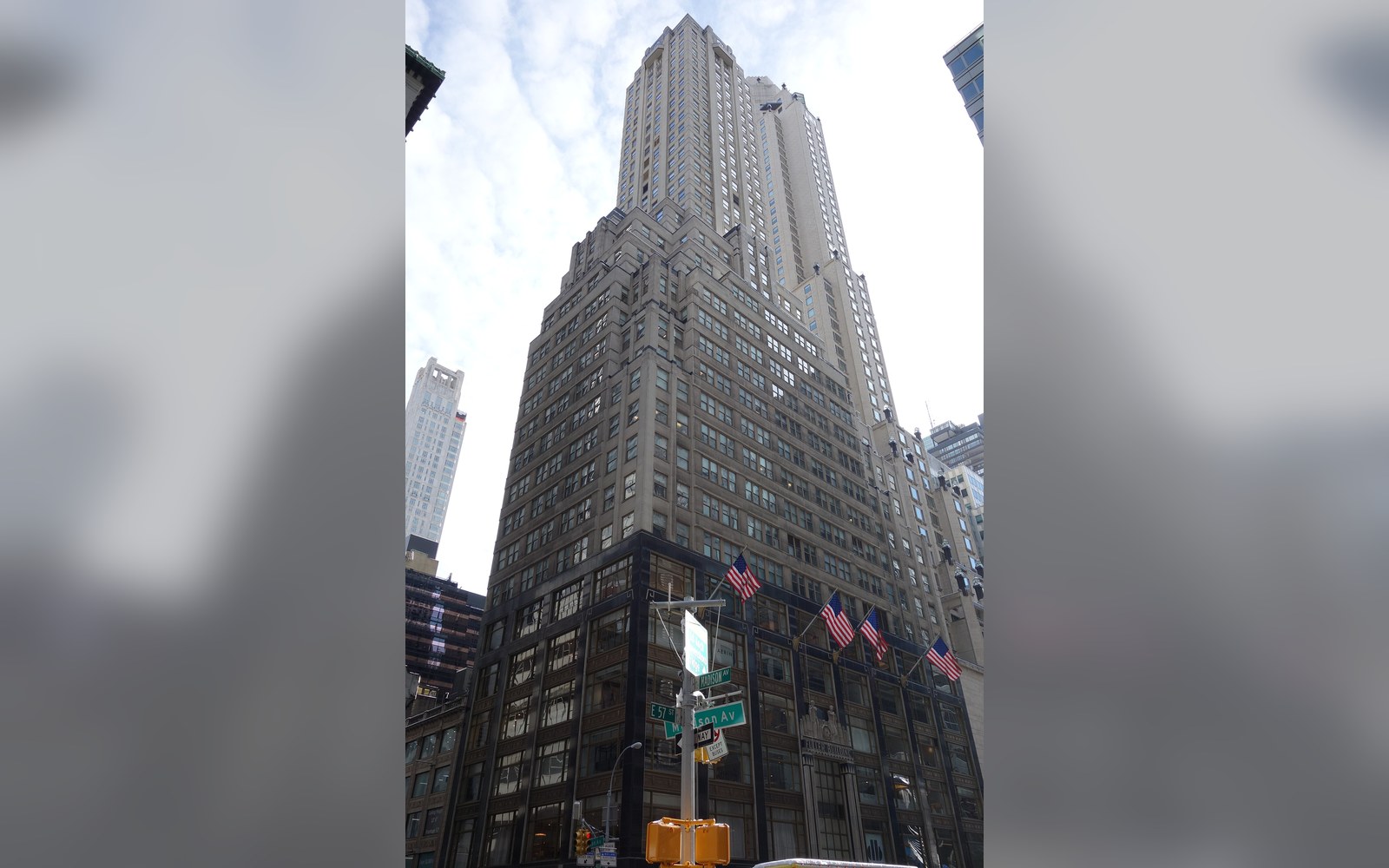
Pierre Matisse Gallery, 41 East 57th Street in the Fuller Building — the most European address in the American trade.
Photo: 57th St Madison Av td 17 - Fuller Building · Wikimedia Commons
A Room Full of the Continent
Pierre Matisse, son of Henri, opened his gallery at 41 East 57th Street in 1931, taking space inside the Fuller Building — the 1929 limestone-and-black-granite tower at the corner of 57th and Madison that had already begun consolidating the Manhattan art trade under one roof. He would remain there until his death in 1989, operating one of the longest-running and most consistently distinguished programs in New York gallery history.
Where other 57th Street dealers worked primarily with American painters, Matisse built a program rooted in the School of Paris and its immediate heirs. He represented Joan Miró in America from the early 1930s, and Alberto Giacometti from the late 1940s — relationships that gave American collectors and museum curators their principal access to both artists for decades. He also represented Balthus, bringing the reclusive Swiss-French painter's unsettling figurative work before a New York public that had no other easy route to it. Fernand Léger and Jean Dubuffet were among the gallery's artists at various points, reinforcing a program whose logic was relentlessly transatlantic.
A hall hired for five days, where the route between dealers is built rather than found.
Photo: Tahir Xəlfəquliyev / Pexels
The Fuller Building address was not incidental. The Fuller Building at 595 Madison had been designed with gallery tenancy in mind: high ceilings, generous natural light on the upper floors, and an address that placed a dealer squarely within the social geography of midtown collecting. Pierre Matisse occupied the building's 41 East 57th Street entrance, and the specific prestige of that address — distinct from the Madison Avenue facade — gave the gallery a slightly separate identity even within the building's cluster of dealers.
Unlike dealers who positioned themselves as promoters of the new, Matisse ran the gallery as something closer to a curatorial enterprise. He was a rigorous selector, slow to add artists and disinclined to follow market shifts. That conservatism, if it can be called that, gave the program a coherence that outlasted many flashier operations. When the Museum of Modern Art wanted to build its holdings of Miró or Giacometti, Pierre Matisse was the obvious first call.
- 1929Fuller Building completed at 41 East 57th Street / 595 Madison Avenue
- 1931Pierre Matisse opens gallery at 41 East 57th Street
- 1930sMiró representation in the United States begins
- Late 1940sGiacometti added to the program
- 1989Pierre Matisse dies; gallery closes
- Post-1989Archive acquired by the Pierpont Morgan Library, New York
After his death in 1989, the gallery's remaining stock — drawings, paintings, correspondence and archival material — passed to the Pierpont Morgan Library, which holds the Pierre Matisse Gallery Archive, running to more than two hundred boxes. That archive is among the most detailed records of mid-century transatlantic dealing in existence. The gallery itself did not survive its founder. Fifty-eight years at one address, one curatorial vision, no successor.
The Fuller Building address was not incidental.
Elsewhere in 57th Street: The Fuller Building, 595 Madison Avenue, 1929: Manhattan’s de facto gallery tower, floor by floor, and later the Pace address. The Fuller Building and What Pace Did With It
Photo: Faheem Jackson / Pexels